Category: Individuals

From Driving the Funeral Van to Feeding Cancer Patients, Shimla’s ‘Vela’ Bobby Does It All for Free!

An urge to serve the society pushed Sarbjeet Singh to set up a free canteen for cancer patients, drive a free funeral van for the poor and organize regular blood donation camps to help Shimla’s hospitals.
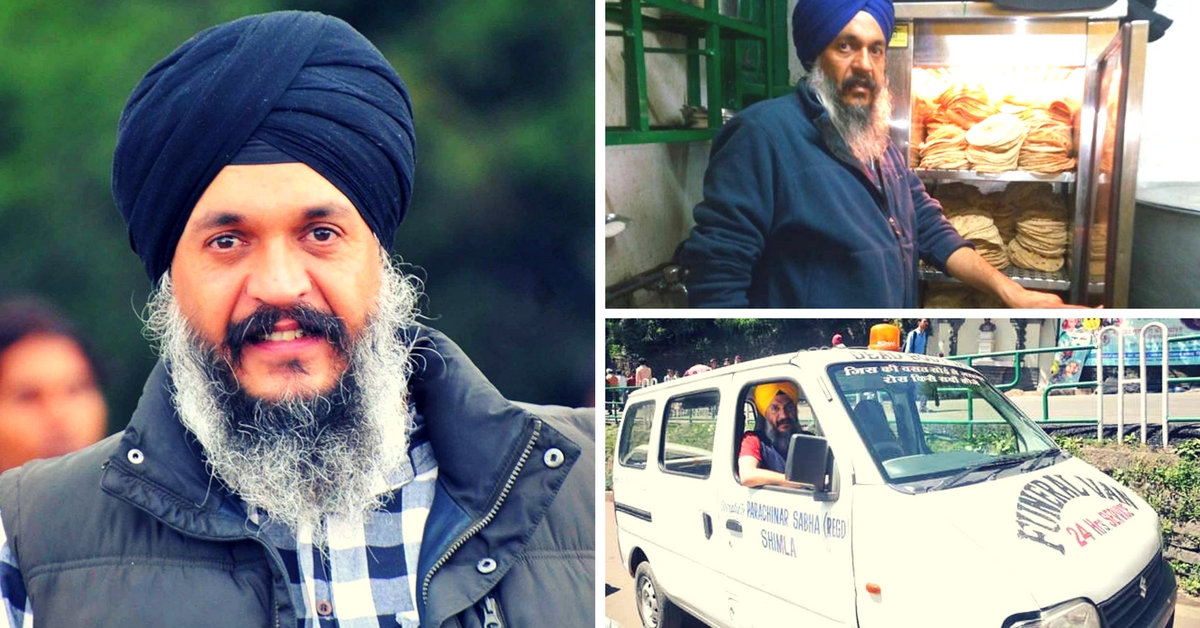
Popularly known as ‘Bobby ji’, Sarbjeet Singh has been working to uplift and serve the underprivileged people of Himachal Pradesh for years. At a time when even paid drivers were not keen on doing it, this good samaritan volunteered to drive dead body van free of cost for the poor. For the last 10 years, he has also been organising blood donation camps for hospitals, and a couple of years ago, he has started a free canteen for cancer patients and their attendants at Shimla’s only cancer hospital.

Here is the heartwarming story of this hardworking man, who has shown what one inspired individual can achieve when he, or she, sets his/her mind to do it.

Unlike most people, who are pre-occupied with their own lives and responsibilities, Sarbjeet Singh spends so much time in social work that the people who know him affectionately call him ‘Vela Bobby’ – ‘vela’ in Punjabi means someone who does nothing and thus has a lot of time on his hands!Advertisement

“People in Shimla call me Vela Bobby. Even my mother does the same! It doesn’t offend me. Instead I am thankful that the almighty made me ‘vela’ so that I could spend my time in the service of humanity,” says the man who has made selfless service the mission of his life.

Talking about his experiences in an exclusive interview to TBI, Singh explains how his journey as a dedicated social worker began.

“It all started twelve years back when I used to volunteer with the local gurudwara and help them organise blood donation camps. Over time, the gurudwara gradually stopped organising blood donation camps. However, I decided to continue organising camps on my own.

Shimla, being the capital of Himachal, is where people from all over the state came for treatment. As a result, there is always a shortage of blood in Shimla’s main hospitals – Indira Gandhi Medical College (IGMC) and Kamala Nehru hospital. So, I knew that I had to continue organising these blood donation camps.”

Sarabjeet Singh has been organising blood donation camps every Sunday for over 11 years now and has collected over 20,000 units of blood for Shimla’s hospitals. All the blood banks in the state have his phone number and know they can rely on him in case of an emergency.

For the past eight years, Singh has also been running a free 24×7 funeral van service to help the dead in their final journey, be it night or day. He has never refused a call, even at odd hours, to transport a dead body to the cremation ground if the vehicle is with him. He has even transported badly decomposed bodies, lying unclaimed at the hospital mortuaries, for the last rites by the Shimla Municipal Corporation.

Explaining that the idea came to him when he saw that even government-run hospitals lacked this facility, Singh says,

“Back then, cremation and burial grounds used to be pretty far from the hospitals which had no vehicle for transporting dead bodies. As a result, many families used to find it difficult to transport the dead bodies for their last rites. Also, after 5 pm, the people were helpless as there was no facility in town to help them do this.

Since I also like driving, I decided to lend a helping hand by driving a funeral van (run by the local Guru Nanak Sewa Society) to ferry bodies 24 x 7 and free of cost. In 2012, with help from citizens, I bought my own crowdfunded van for the free service. Till date, I have ferried more than 5,000 bodies.

While it is a macabre job, the experiences I have had while driving the funeral van have taught me many things. I still remember the time when I ferried a 9-year old girl’s body to her distraught mother’s home. It was the first time I had truly realised the importance of my job and it just strengthened my resolve to continue my service. I felt perhaps God himself had given me this duty. Soon after, I started my NGO, Almighty Blessings. “

In 2014, under the banner of his NGO, Almighty Blessings, Sarbjeet Singh started a free canteen for poor patients and their attendants at Shimla’s only cancer hospital. He says, “I realised that people from all over the state, some from really remote places, visited this cancer hospital and it didn’t even have a canteen to serve them! Some of them are so poor that they can’t even afford medicines for the treatment, let alone food. That’s when I decided to do something about this.Advertisement

The free canteen I opened started out by offering tea and biscuits for free to patients and their attendants. I wanted to ensure that everyone of them at least got a cup of hot tea in the cold mornings of Shimla. Today, I am very happy to say that the canteen now serves tea, biscuits, soup, daliya and dal-chawal for free to the patients and their attendants every day.”

Source: http://associationthankyou.org/index.php/2022/04/08/from-driving-the-funeral-van-to-feeding-cancer-patients-shimlas-vela-bobby-does-it-all-for-free/
Categories: Individuals

An IAS officer, a former Chicago risk analyst, is making Tirunelveli oxygen-smart

District Collector Vishnu Venugopal says Indian bureaucracy is like a ‘black box’, but can transform lives. Villagers have named a hamlet after him in gratitude for his work.

SONIYA AGRAWAL 19 May, 2021 1:00 pm IST

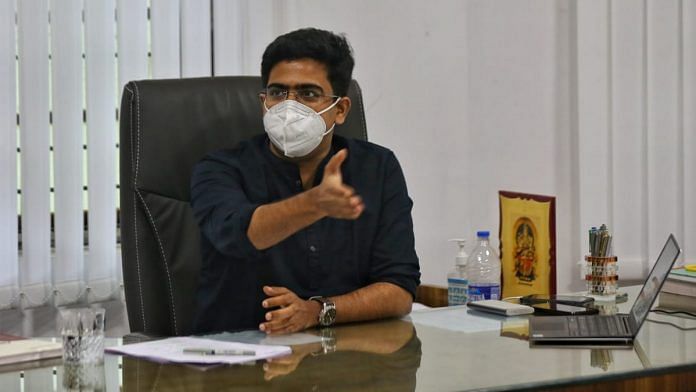
IAS officer Vishnu Venugopal, the District Collector of Tirunelveli in Tamil Nadu | Photo: Suraj Singh Bisht | ThePrint

Tirunelveli: District Collector Vishnu Venugopal seems to have a looming crisis at hand Sunday, when Tirunelveli only has three tonnes of oxygen left — enough to last till 1 am. But that’s when the 35-year-old IAS officer’s past work as a risk analyst with British insurance giant Aon’s Chicago office comes in handy.

Venugopal’s hands-on live oxygen tracking and dashboarding of the Covid situation has made Tirunelveli the district with the lowest per capita oxygen consumption in the state of Tamil Nadu, even though it has a high Covid case load — as on 18 May the number of active cases in the district was pegged at 6,528.

That’s not to say there aren’t problems — Venugopal spends most evenings devising ways to make the oxygen supply last till replenishments arrive the next day.

On this day, with just four hours left for the oxygen stocks to run out, the civil servant gets on a call with anaesthesiologists deployed in the 920 oxygen bed-capacity Tirunelveli Medical College, the largest Covid facility in the district, to chalk out a plan to last the night.

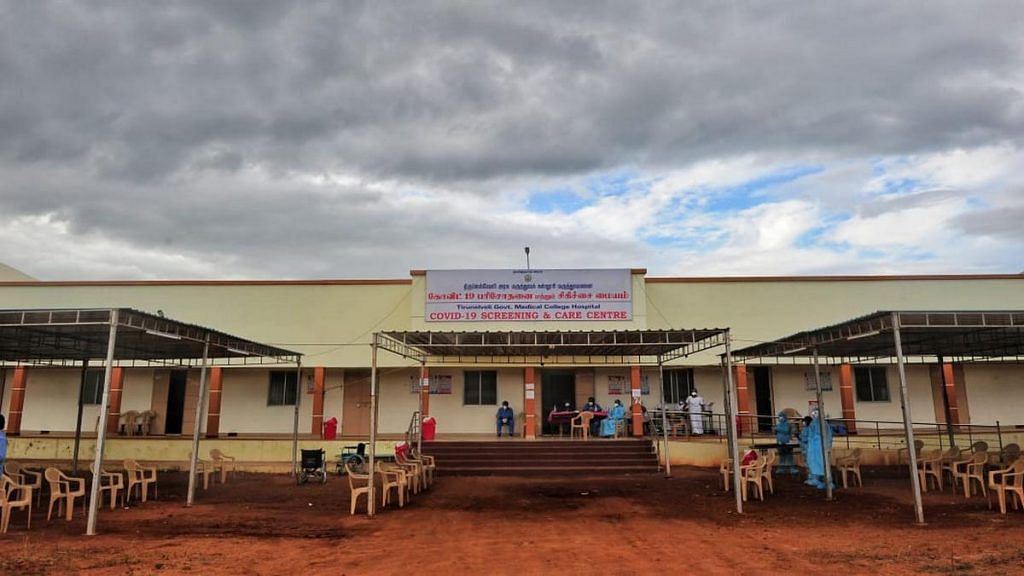
The Covid screening and care centre building at the Tirunelveli Medical College | Photo: Suraj Singh Bisht | ThePrint

“We are surviving on an hour-to-hour plan, with limited oxygen and increasing Covid cases. Nights are the most challenging; that is the time when most patient distress calls pop up and the oxygen requirement shoots up,” engineer-turned-IAS officer Venugopal tells ThePrint.

Oxygen optimisation 

The mantra for Venugopal’s model of governance amid the second wave of the Covid-19 pandemic is oxygen use optimisation. To reduce oxygen consumption in the district, the DC has, with the help of doctors, devised a three-pronged strategy.

“A month back, when cases started increasing, we assigned 30 nurses to only monitor the oxygen flow in patients. Our oxygen consumption was high the first two days, after which the nurses figured out the right amount of oxygen flow that should be maintained. Our oxygen consumption has dropped to 5.8 kilo litres a day, and we have maintained it,” Venugopal told ThePrint.

Tirunelveli receives 0.3 kilolitres of oxygen from the Indian Space Research Organisation’s (ISRO) Propulsion Complex located in the district, while the Tamil Nadu Medical Services Corporation supplies varying amounts of liquid oxygen according to availability.

The ‘oxygen’ nurses, working in two shifts between 5 pm and 5 am, monitor its consumption by patients. Their job is to check the pulse oximetry of patients and maintain it to the lowest level required. Since oxygen is addictive when given in any amount, these nurses counsel patients and help recovering patients with demasking — the process of weaning them off oxygen masks.

Dr K. Shantaraman, vice-principal of the Tirunelveli Medical College, explained the optimisation of the oxygen and dynamic pooling of oxygen beds by saying: “The treatment is not about giving patients volume of oxygen, but getting the inflammation down. Oxygen wastage is a common problem that hospitals are facing; we give optimal amounts of oxygen only to patients with 85-90 SPO2 levels.”

He added: “We are using non-rebreather masks for moderately ill patients; this has helped reduce oxygen wastage. Not only this, we have kept the oxygen supply available to all beds. This means non-oxygen beds can anytime be converted into oxygen beds as and when required.”

Additionally, postgraduate students of anaesthesia have been roped in to help with managing Covid patients’ care, and some of them are deployed to keep an eye on the oxygen equipment and its flow. They also keep a check on the patients who need to be taken off oxygen if they have stable SPO2 levels.

IAS officer with a hamlet named after him

Vishnu Venugopal comes from humble origins in Kochi, Kerala — his father, a guard with the railways, passed away when he was in Class 8, and mother Sheela became the sole breadwinner of the family.

The young Venugopal went on to graduate from the National Institute of Technology in Tiruchirappalli, and also has a degree certification in port management from Belgium, and was awarded the prestigious Eisenhower Fellowship in 2019.

He worked as a financial risk analyst for Aon in Chicago in 2009-10, helping clients determine the level of risk involved in making a particular business decision.

Venugopal appeared for the civil service exam because he wanted to be actively involved in the nation-building process, and made it to the IAS in the 2011 batch.

He says while the Indian bureaucracy seems like a mysterious ‘black box’ from the outside, it has the power to transform lives, and he wants to use the reach of the system to bring transparency in governance.

Venugopal was promoted to the post of District Collector only five months back. Before that, he was a sub-collector, and his work was so appreciated that villagers renamed Vakaikulam, a hamlet where 45 families live, to Vishnu Nagar. They said this was their way of showing gratitude for “bringing light to their dark village”, as his initiatives literally brought electricity and water to their homes.

Now, as DC, Venugopal spends his afternoons speaking to doctors in the various blocks of Tirunelveli, having begun his day by inspecting Covid Care Centers and interacting with the public at 8 am. The barrage of calls usually ends at around 2 am, 18 hours later.

Command centre works from home

Unlike other Covid command centres across the country, the one in Tirunelveli stands empty. The person in charge, who did not wish to be named, said: “All our staff is working from home. We have a dashboard using which we communicate and do our tasks.”

Explaining the logic behind the move, the DC said: “These command centres can be potential super spreaders. In order to check that all the work is happening remotely, we have created a robust online system, with the help of which the team functions.”

Collector Vishnu Venugopal works on the district's Covid dashboard | Photo: Suraj Singh Bisht | ThePrint
Collector Vishnu Venugopal works on the district’s Covid dashboard | Photo: Suraj Singh Bisht | ThePrint

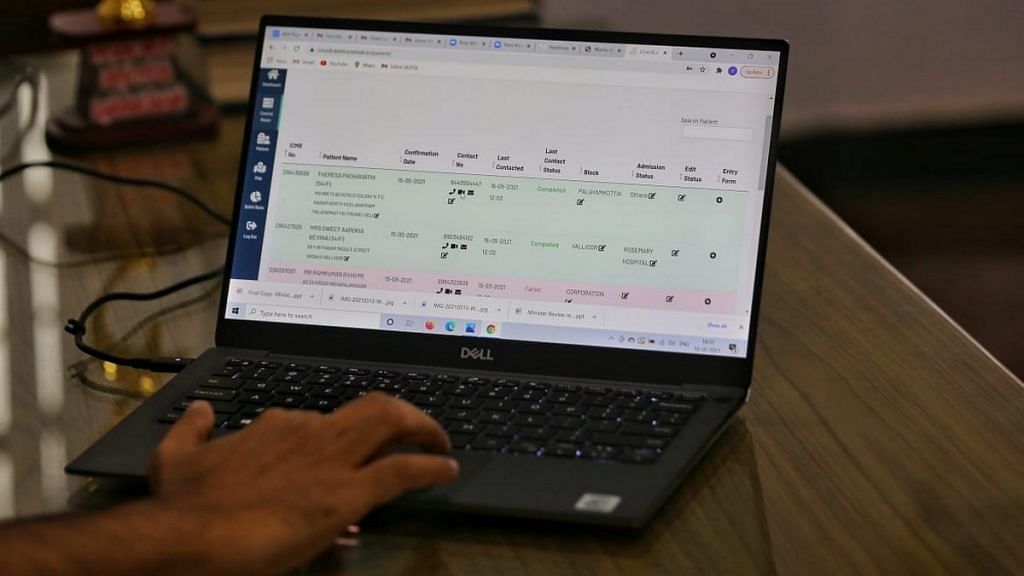
One side of the dashboard, in Tamil, can be accessed by residents for Covid-related healthcare services. The administration’s side of the dashboard, meanwhile, features details of every Covid patient, downloaded from the ICMR website. The district’s Covid team makes regular calls to patients, and the collector says he listens in to 10 per cent of calls to check quality.

The district also started doing ‘testing swipes’ — camps were set up and a large number of people were tested to unearth Covid cases and prevent further spread. “As soon as we were able to identify the index case (the first documented case, which in this instance was a man working in Thoothukudi) in the month of April, we doubled our testing. Initially, our Covid numbers were very high, but that was because we eliminated Covid cases from the general populace early on with amped up testing,” Venugopal said.

A member of the nursing staff checks the oxygen levels of a patient at the Tirunelveli Medical College | Photo: Suraj Singh Bisht | ThePrint

“In order to test more people, we doubled our testing capacity to 2,500 tests a day. Although private testing labs do contribute whatever little they can, the government facility pulls the maximum load. We have created three time slots throughout the day when the RT-PCR machines run at full capacity,” he added.

Safety of Kani tribe

Another challenge facing the IAS officer and his team is the safety of the Kani tribe that lives deep in Tirunelveli’s forests. It is the age-old administrative dilemma — should any kind of intervention be made into an area with no Covid cases, or leave the members of the tribe alone?

“Since they are far removed from civilisation, Covid has not reached them. We want it to remain that way; hence, no physical contact has been made with them,” said Venugopal.

He added that about 15-20 families of the tribe live deep in the forests, and even reaching them requires a 15-kilometre trek deep into unfamiliar parts of the jungles on the coast. Since there have been no cases in the area, he has chosen to not conduct a vaccination drive there.

“If at all they need anything, they reach out for help. All the tribal leaders have my phone number anyway,” Venugopal said.

(Edited by Shreyas Sharma)

Source: How this IAS officer, a former Chicago risk analyst, is making Tirunelveli oxygen-smart (theprint.in)

Categories: Individuals

34-year-old Indian-American doctor has returned to his motherland to fight against covid

As India’s fight against COVID-19 continues Harmandeep Singh Boparai, a 34-year-old Indian-American doctor has returned to his motherland and is doing his bit in his home town Amritsar.

Image

As the nation struggles to contain a second wave of the Covid-19 pandemic, this 34-year-old Indian-American Sikh doctor has returned to his roots and is doing his bit in defeating the virus.

Harmandeep Singh Boparai, who was working as frontline worker in New York, Unites States, is currently treating Covid patients in his home town Amritsar.

His next stop will be a 1,000-bed hospital in Mumbai, where he has been roped in by Doctors Without Borders, an international medical humanitarian organisation. He is scheduled to leave for Mumbai on Monday and will serve at the facility for the next couple of weeks.

A specialist in anaesthesiology and critical care, Dr Harman, who did his MBBS in Amritsar Government Medical College before moving to New York in 2011, has also imparted training to many doctors and nurses in the holy city, especially at Dukh Niwaran Hospital, at par with the modalities being used in New York hospitals. He returned to India on April 1 this year.

Harman says he would continue extending his help to all those in need until the situation becomes normal in India. His father, RPS Boparai, is an orthopaedic specialist, while his mother, late Gian Kaur, was a gynaecologist. Harman said his mother, who passed away in 2011, had inculcated the value of sewa (volunteer service) in him during his childhood and young age.

“As soon as I came back to India, though the cases were not so high at the time, I started talking to the doctors here on how we can build capacity in case cases surge, apart from strengthening the infrastructure to handle any kind of crisis. Soon enough, we saw a catastrophic rises in the cases in India. I have been able to build a capacity for intensive care at Dukh Niwaran Hospital, besides imparting training to the nurses and doctors regarding the Covid protocol that I learnt in New York during the first wave,” Harman said.

Dukh Niwaran Hospital, which has now been given on lease, was run by Harman’s father as a charitable hospital.

Sharing his views on India’s Covid situation, he said, “We have not been able to contain the spread of the virus for various reasons here, even though we had time to prepare for the bad waves as were seen across the world earlier. We could have vaccinated many more people so far. But, due to issues in the system, help couldn’t reach many in time.”

He said, “Doctors in the health department, especially in Punjab, have been working so hard in order to save lives. We must continue to support them and give them our best wishes and solidarity, for this is not an easy job.”

He also advocated imposing lockdown to break the chain of transmission.

Source: Indian-American Sikh doctor returns to roots to assist in Covid fight | Hindustan Times

Categories: Individuals

Dolly Arjun tries to help India’s Covid patients specially the Dalit (or “untouchables”) and others without health access over the phone.

By Dan Levin

Members of the global Indian diaspora, nearly 17 million, have mobilized from afar to help back home, where the Indian health system is buckling under the weight of a devastating coronavirus wave. Here is one U.S. resident’s story.

The calls come at all hours, sometimes 15 a day, from some of India’s most oppressed and severely ill people, buzzing a cellphone that belongs to Dolly Arjun, an Indian-American physician assistant in Boston.

A few years ago, Ms. Arjun founded a telehealth program to provide free health care to members of India’s Indigenous tribes and to Dalits, who are at the lowest rungs of India’s entrenched caste system and have long faced discrimination. Dalits are typically the last to receive assistance in humanitarian disasters and often live in impoverished rural villages with no hospitals, medical care or schools.

Now, with a devastating wave of coronavirus infections surging across India, Dalits are facing a new peril, Ms. Arjun said. She said she was desperate to help, even though she is emotionally exhausted after a year of working with Covid-19 patients in Massachusetts.

“Tons of people are dying,” Ms. Arjun said. “This is just a human to human need.”

Her focus is not just Hippocratic. She is Dalit herself, a rarity among Indian medical professionals in the United States, most of whom come from upper-caste urban families. “The only reason they might know a Dalit person is because it’s their servant at home,” Ms. Arjun said.

Her telemedicine program has health workers in India who can translate for patients in local languages, but finding medical professionals in the United States to join the effort has not been easy, she said. Still, Ms. Arjun has recruited two physicians.

Patients contact the group through WhatsApp, Facebook and YouTube, and the medical professionals call back on video. Often their first task is to reassure patients who have little understanding of the coronavirus or the appropriate medical treatments, Ms. Arjun said.

“Part of what’s happening now is patients are being told Covid is going to kill you, so they are panicked,” Ms. Arjun said.

She noted that in one Indian state the government has been broadly distributing packets of medications — including 25 days-worth of antibiotics, which cannot treat viruses — to residents, regardless of whether they have tested positive for Covid-19 or show symptoms.

Sometimes, however, the telehealth calls detect life-or-death emergencies. In late April, Ms. Arjun logged onto a WhatsApp video call with a young Dalit man and his 60-year-old father, who was at home with breathing problems in the central Indian state of Madhya Pradesh, where it was around midnight.

“They didn’t know what to do,” she said. “They told us there were no hospitals or oxygen available, and they hadn’t seen a doctor.”

After assessing the man, Ms. Arjun urged the family to check to see whether any hospital beds were available instead of assuming that they were full. “It took a lot of convincing,” she said.

The next day, he was admitted and began to improve, but the hospital was running out of oxygen. Ms. Arjun put out a call on several WhatsApp groups for an oxygen cylinder, though the family did not know the name of the hospital and then fell out of contact.

Days later, she learned that the man had died.

Source: Boston Health Worker Helps India’s Covid Patients Over the Phone – The New York Times (nytimes.com)

Categories: Individuals

Jitendra Shinde (rickshaw driver) gives free hospital trips to thousands

Jitendra Shinde has put his health and personal finances on the line since March 2020

‘There’s no leave in this work,’ says Jitendra Shinde, a rickshaw driver in Kolhapur city who has dropped over 15,000 patients to hospital for free. Sanket Jain for The National
Often people get to know of Jitendra from patients he has helped. Sanket Jain for The National
Jitendra dropping a patient to a hospital on the outskirts of the city. Sanket Jain for The National
First, he sanitises the hands of the passengers and only then allows them to sit. Sanket Jain for The National
Jitendra takes all the precautions before dropping any Covid patient. Sanket Jain for The National
He spent 5,000 rupees on PPE kits. Jitendra takes all the precautions before dropping any Covid patient. Sanket Jain for The National
Jitendra drops patients to any hospital in Kolhapur city free of charge. Sanket Jain for The National
Jitendra drops the patients to any hospital in Kolhapur city for free. Sanket Jain for The National

A selfless Indian rickshaw driver has worked tirelessly to ferry 15,000 people to hospital during India’s Covid-19 crisis.

Jitendra Shinde, 50, says that 1,000 of his passengers had Covid-19 symptoms.

Each and every one has been recorded in a diary kept by the driver, who has put his health and personal finances on the line to help society.

When Mr Shinde first wore personal protection equipment, the entire community was scared. Little did they know he was on a mission.

“No one came close to me,” he remembers. He started using his auto rickshaw to help Covid-19 patients.

“It was an SOS call. A labourer whose oxygen saturation level fell below 90 had tested Covid-positive and he dialled me,” Mr Shinde said.

This was in the last week of March 2020.

Mr Shinde quickly dropped the labourer off at the Kolhapur’s CPR hospital in western India’s Maharashtra state.

Fourteen days later, he got a call from the same labourer: “I’ve defeated Covid.”

With a sigh of relief, Mr Shinde moved on to the next call, another request to drop a patient at the nearest hospital.

He receives several hundred SOS calls every week and ferries patients with any medical illness to hospitals in Kolhapur city for free.

He first started this community service on March 24, 2020 – the day Indian Prime Minister Narendra Modi declared the world’s biggest lockdown, affecting 1.3 billion people.

Within a year, he ferried more than 15,000 people – about 40 a day – including more than 1,000 coronavirus patients.

“If someone tests Covid positive, society makes them a pariah. How will such people reach hospitals or quarantine centres?” Mr Shinde asks.

With India now reporting over 300,000 cases in a day, health infrastructure is strained beyond capacity across most of the country.

Mr Shinde continuously seeks updates on the number of vacant beds in hospitals and quarantine centres.

“First, I ask people their location, the problems they are facing, and then I take them to the nearest possible hospital.”

His list of passengers includes pregnant women and people with disabilities.

“Within a year, I dropped off 70 pregnant women to hospitals,” he says.

To ensure safety, he always sanitises the hands of the patients before letting them enter the auto rickshaw.

Kolhapur district, which has the highest death rate in Maharashtra, at 2.7 per cent, is in the middle of a humanitarian crisis.

“In several cases, no one comes to lift the bodies of the deceased Covid patients,” Mr Shinde says.

At such times, he helps to transport the bodies and to perform the death rituals according to their beliefs, ensuring the dignity of the victims is not lost.

While ambulances in Delhi and other parts of India are charging as much as 8,500 rupees ($115) for a five-kilometre journey, he will not take any money.

So far, Mr Shinde has spent 150,000 rupees of his savings to help people. He spent another 5,000 rupees to buy PPE kits.

“No one has come forward to help me, and neither do I expect them to,” he says.

“Every day I have to spend at least 200 rupees on fuel.”

Mr Shinde explains how people still fear him when he wears PPE.

“They think I am Covid-positive, or I might spread the virus.”

For recovering Covid patients and those in home isolation, he delivers medicine, vegetables and essential groceries, funding everything through paid trips for passengers who are not ill.

Mr Shinde’s work comes with its own set of challenges.

“Fellow rickshaw drivers don’t allow me to park my auto in the stand. They shun me, saying, ‘What if you infect us?’”

Mr Shinde suspects that some of them stole 5,000 rupees from his rickshaw a few months back.

“I don’t care about the money lost, but they even stole my diary where I had written the names of the patients I helped.”

He says his motivation to help comes from his childhood when “I couldn’t even bid goodbye to my ailing parents with dignity”.

Mr Shinde was only 10 years old.

“Whenever I help any patient, it feels like I am helping my parents and that’s why I do this work every day,” he explains.

Last year, for seven months, he would isolate himself after returning from work.

“Now, I’ve taken both doses of the vaccine,” Mr Shinde says. “However, I still wear a mask.”

He responds to his call of unpaid duty in the quickest possible way.

“I am not allowed to use a siren in my auto but when it’s an emergency, I put it on. What will you do if the patient dies?” he asks.

There have been times he was caught by the local police for breaking the lockdown rules. He tries to explain the urgency of the issue, but if nothing works, “I dial the senior police officials, who let me go”.

Not a day goes by that Mr Shinde does not hear from people he helped.

“That joy is what I live for,” he says.

In the August 2019 floods that devastated western Maharashtra, he saved about 500 people from the nearby village of Chikhali.

“I would drop the rescued villagers to safer places,” he says proudly. He also distributes food to the homeless and daily wage earners who lost their jobs in the lockdown.

He travels as far as 110km to the villages of Belagavi district on the border of Karnataka state to help patients.

Mr Shinde is proud of not turning away any request.

“People donate to temples. I spend money to save lives,” he says. Now, he dreams of starting an old people’s home.

“Tens of people should come forward and help others,” he says. “If my life story inspires someone, I will have done my job.”

Source: India’s Covid-19 crisis: rickshaw driver gives free hospital trips to thousands | The National (thenationalnews.com)

Categories: Individuals